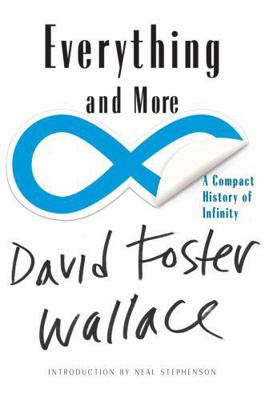
"EVERYTHING AND MORE"
"A COMPACT HISTORY OF INFINITY"
"AUTHOR(s)":
Written such that it feels like Cantor, Et. Al. just kept asking “What If?”
Neal Stephenson writes a foreward about the American education system, specifically how it works (or doesn’t) in the mid-west. Sets the context of the time mathematics come from. A time when you could be killed for “knowledge” or questioning what authority defined as “correct”. “knowledge is perceived as dangerous”. These “rules” (of academic publishing) still apply, today, in Mathematical texts and Wallace doesn’t abide by the rules in this book.
pxxiv - “This tends to be viewed as ‘whippersnapperish’ behavior if induldged in too early in one’s career.”
pxxv - “safe to write” (this is not that)
pxxvi - “writers who produce books on technical subjects aimed at non-techincal readers are doomed to get cranky reviews from both sides… So in writing a boo"k such as Everything and More, DFW reminds us of the soldier wsho earns a medal by calling in an artillery strike on his own position.”
pxxviii - “I will add one piece of advice about how to read this book, which is to relax and pay no attention — beyond of course, reading and enjoying it”
pxxx - “you can explain anything with words if you work hard enough and show your readers sufficient respect.”
pxxi - “you can reach to other minds through that medium of words and make a connection. … ‘here is something cool that I want to share with you for no reason other than making the spark jump between minds.’”
p4 - “VIR” - “Vicious Infinite Regress”
p5 - “without a consistent theory of the mathematical infinit there is no theory of irrational; without a theory of irrationals there is no mathematical analysis in any form even remotely resembling what we now have; and finall, without analysis the major part of mathematics — including geomtery and most of applied mathematics — as it now exists would cease to exist.”
p5 - “Cantor, b. 1845 … father of abstract set theory and transfinit math” … He was in and out of mental hospitals for much of his later adulthood."
At this point I start questioning or at least wondering if there was other motivation or curiosity behind Wallace’s interest in Cantor, and not in a mathematical regard. And not just Cantor, but Godel and Boltzmann. He’s expressing great interest. This is deeper than a single passing thought. I’ve gotten caught in this trap before. Cobain, Wallace, Godel, Cantor, etc.
p7 - “danger does lie in logic, not in imagination.”
It’s not logic that drives one insane, it’s trying to apply logic to the abstract.
p8 - “abstraction. It’s maybe the single most important word for appreciating Cantor’s work.”
p8 - “the root form is the adjectival, from the L. abstractus = ‘drawn away’” where “opposed to concrete. … Ideal, distilled to its essence”
p8 - “But what, after all, are the integers? Everyone thinks that he or she knows, for example, what the number three is — until he or she tries to define or explain it.”
Recommends or references A History of Mathematics and Mathematical Thought From Ancient to Modern Times
p9 - “systematically fooled, or awakened, into treating numbers as things instead of symbols for things. .. this parallels the ways we are taught to use language. We learn early on that the noun ‘five’ means, symbolizes, the integer 5.”
p10 - “‘abstract’ is a term from metaphysics”
p10 - “The father of abstraction in mathematics: Pythagoras. The father of abstraction in metaphysics: Plato.”
p10 - “mathematical entities are abstractions, ideas entertained by the mind. … the moment a system of symbols beomes independent of the objects designated”
p11 - “What does nothing look like?” … “‘Motion’ is a noun, and ’existence’; we use words like this all the time. The confusion comes when we try to consider what exactly they mean.” “Does motion per se exist?” “What exactly is existence?” “abstraction proceeds in levels”
p12 - “surely [you feel him questioning himself; his mental] we’ve all had the experience of thinking about a word — ‘pen,’ say — and of sort of saying the word over and over to ourselves until it ceases to denote; the very strangeness of calling something a pen begins to obtrude on the consciousness in a creepy way, like an epileptic aura.”
p13 - Abstract thinking. Getting out of bed. “The dreads and dangers of abstract thinking are a big reason why we now all like to stay so busy and bombarded with stimuli all the time. Abstract thinking tends most often to strike during moments of quiet repose. As in for example the early morning, especially if you wake up slightly before your alarm goes off, when it can suddenly and for no reason occur to you that you’ve been getting out of bed every morning without the slightest doubt that the floor would support you. … It’s not like you’re actually scared that the floor might give way in a moment when you really do get out of bed. … The principle involved is really the only way we can predict any of the phenomena we just automatically count on without having to think about them. … this confidence based on past experience we’d all go insane, or at least we’d be unable to function …”
p16 - “our only real justification for the Principle of Mathematical Induction is the Principle of Mathematical Induction”
p16 - “The only way out of the potentially bedridden-for-life paralysis of this last conclusion is to pursue further abstract side-inqueries into what exactly ‘justification’ means and whether it’s true that the only valid justifications for certain beliefs and principles are rational and noncircular.”
p16 - “your need/desire to be able to drive functions as a kind of ‘justification’ of your confidence.”
At some fundamental level there has to be trust.
p17 - “at some point you realize that the process of abstract justification can, at least in principle, go on forever. The ability to halt a line of abstract thinking once you see it has no end is part of what usually distinguishes sane, functional people — people who when the alarm finally goes off can hit the floor without trepidation and plunge into the concrete business of the real workaday world — from the unhinged.”
p17 - “an ultrananoinstant of 5x10^(-44) seconds is generally acknowledged to be the smallest time-interval in which the normal concept of continuous time applies.” What is “time”?
p18 - Bremermann’s Limit: “in 1962 ‘No data processing system, whether artificial or living, can process more than 2x10^47 bits per second per gram of it’s mass’”
p19 - “concatenation of abstractions”
p20 - what is “existence”? “In what way do abstract entities exist, or do they exist at all except as ideas in human minds”
p20 - “are mathematical realities discovered, or merely created, or somehow both?”
p20 - “there is nothing more abstract than infinity.” You can’t experience infinity in any way.
p21 - “at what point do the questions get so abstract and the distinctions so fine and the cephalalgia so bad that we simply can’t handle thinking about any of it anymore?”
p22 - one of the weirdest attributes of an average human mind is it’s ability to conceive of the unconceivable
p22 - “We ‘know’ a near-infitinity of truths that contradict our immediate commonsense experience of the world. And yet we have to live and function in the world. So we abstract, compartmentalize: there’s stuff we know and stuff we ‘know’.”
p25 - “Math is … a formal system … 100% abstract” “The core idea is that mathematical truths are certain and universal precisely because they have nothing to do with the world.”
p26 - the Law of the Excluded Middle (LEM): “a mathematical proposition P must be either true or, if not true, false.”
p28 - “Many of the really great, famous proofs in the history of math have been reductio proofs.”
p30 - “a language is both a map of the world and its own world, with its own shadowlands and crevasses — places where statements that seem to obey all the language’s rules are nevertheless impossible to deal with.”
p31 - “self-reference” GEB.
p33 - “the problems and controversies about [infinity] that are going to concern us here involve whether infinite quantities can actually exist as mathematical entities.”
p33 - “language of math” three men check into a motel for $30 ($10 each), they get a $5 refund. They each take $1 then give $2 to the doorman. Now, we can make a dollar dissappear by rephrasing this a bit and allowing our mind to do some mental gymnastics. Since they each took $1, this is the same as if they originally each paid $9. 9x3 = $27 + $2 (the doorman) = $29. “the point is the verbiage”
p42 - “Cantor was 100% a man of his time and place, and his accomplishments were the usual conjunction of extraordinary personal brilliance and courage.”
p43 - “the abstract intertwined dance of infinity and limit. … math’s historical struggle with representing continuity.”
p44 - limited by our beliefs which were influenced or constructed by the ancient Greeks.
p45 - “messy” or confusing indicated a natural “incorrectness”
p46 - metaphysics and beauty ruled Pythagoreans and therefore, math
p52 - “The trouble with college math classes — which classes consist almost entirely in the rhythmic ingestion and regurgitation of abstract information, and are paced in such as way as to maximize this reciprocal data-flow — is that their sheer surface-level difficulty can fool us into thinking we really know something when all we really ‘know’ is abstract formulas and rules for their development. Rarely do math classes ever tell us whether a certain formula is truly significant, or why, or where it came from, or what was at stake. … why a problem is an actual mathematical problem and not just an exercise.”
p55 - due to VIR you can’t truly “know” anything. “knowing” is impossible. “In order know that x, you must know that you know that x. … In order to know that [you know that you know that x], you must know that you know that [you know that you know that x] and so one, ad inf.”
p56 - our definition of math is rooted in philosophy and experience and perception
p58 - “Form is what really, ultimately exists, whereas individual men are just temporal appearances of the Form, with a kind of borrowed or derivative existence, like shadows or projected images.”
p59 - “formal relations between abstractions”
p61 - math is a composition of abstraction layers
p61 - “a towering baklava of abstractions and abstractions of abstractions.”
p65 - “The distinction is between actuality and potentiality”
p71 - “In fact the more fundamental the math concept, the more difficult it usually is to define. This is itself a characteristic of formal systems”
p106 - “the late 1600s mark the start of a modern Golden Age” involving the first forms of abstraction. from the maths of the Greeks to Galileo which was empirically based.
p226 - “mathematical truths do not exist apart from human minds.”
p243 - transfinite properties
p252 - Cantor figures out how to sequence the array’s rationals via a single continuous zigzaggy line
p270 - “either a is a member of s, or it isnt’”
p302 - undecidability
p305 - “Mathematics continues to get out of bed.” i.e., we keep trusting axioms without proof.