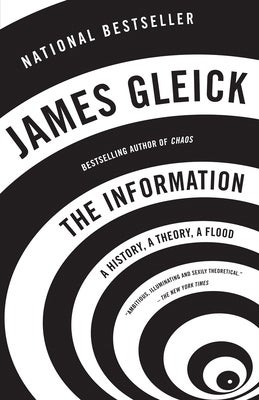
"THE INFORMATION"
"A HISTORY, A THEORY, A FLOOD"
"AUTHOR(s)":
This author came as a rec from a colleague, Peter T.
p3 - “Frequently the messages have meaning - Claude Shannon”
p3 - “for once the reality surpassed the hype.”
p4 - “a thirty-two-year-old named Claude Shannon. The bit now joined the inch, the pound, the quart, and the minute as determinate quantity — a fundamental unit of measure.”
p7 - “transmission of intelligence”
p13 - “drums that talk … the thump of the drum could carry six or seven miles. Relayed from village to village, messages could rumble a hundred miles or more in a matter of an hour. … The meaning of the message had, of course, to be prearranged, effectively condense into a single bit.”
p25 - “Every ambiguous word begins in a cloud of possible alternative interpretations” - This is “information” as Shannon defines it if you read the original “A Mathematical Theory of Communication”
p26 - “the fewer symbols available, the more of them must be transmitted to get across a given amount of information.”
p30 - “For this invention will produce forgetfulness” - Plato when talking about written language
p32 - “There is a progression from pictographic, writing the picture; to ideographic, writing the idea; and then logographic, writing the word.
p38 - “things are members of classes”
p40 - “Can it be that a white horse is not a horse? It can. How? ‘Horse’ is that by means of which one names the shape. ‘White’ is that by means of which one names the color. What names the color is not what names shape. Hence, I say that a white horse is not a horse.”
p40 - “Are these classes part of reality, or do they exist only in language?”
p53 - “few had and concept of ‘spelling’” people would change spelling throughout text. “Language did not function as a storehouse of words [it was a store of ideas or information]. … To spell (from an old Germanic word) first meant to speak or to utter. Then it meant to read, slowly, letter by letter. Then, by extension, just around Cawdrey’s time, it meant to write words letter by letter.”
p55 - “Influence, to Robery Cawdrey, meant ‘a flowing in.’”
p57 - first dictionary. Then an ordering of the alphabet. Why was ‘a’ early? Humans like order and predictability. “Topical lists were thought provoking, imperfect, and creative. Alphabetical lists were mechanical, effective, and automatic.”
p62 - “[Galileo in 1611] sensed that science could not proceed without first solving a problem of language”
p66 - “The dictionary ratifies the persistence of the word. It declares that the meanings of words come from other words. It implies that all words, taken together, form an interlocking structure.”
p72 - “Lexicographers are accepting the language’s boundlessness.” The growth rate of language is now faster than the persitance rate.
p82 - “Babbage static statistical table” … starting to collect data. power of data recognized.
p87 - “Knowledge has a value and a discovery cost, each has to be counted and weighed.”
p90 - “Thinking about language, while thinking in language, leads to puzzles and paradoxes.”
p90 - “they so often saw language not as a perfect vessle for truth but as a leaky sieve.”
p99 - “a junction point for two roads — mechanism and thought.”
p101 - “Babbage himself was self-conscious about anthropomorphizing but could not resist.”
p112 - an open, curious, mind in a time of closedness
p112 - “Those who have learned to walk on the threshold of the unknown worlds…may then with the fair white wings of Imagination hope to soar further into the unexplored amidst which we live.”
p120 - hype
p120 - “They all spoke as though the engine were real, but it never was.”
p121 - “Babbage’s interests … seeming so miscellaneous, did possess a common thread that neither he nor his contemporaries could perceive. … His true subject was information… Deciphering… I fear I have wasted upon it more time than it deserves.”
p124 - “he told a friend that he would gladly give up whatever time he had left, if only he could be allowed to live for three days, five centuries in the future.”
p125 - collective information “the round globe is a vast head, a brain”
p131 - “Certain signals were reserved for error correction and control”
p137 - “an alphabet of motions”
p146 - “‘Intelligence, thus hastily gathered and transmitted, has also its drawbacks, and is not so trustworthy as the news which starts later and travels slower.’”
p146 - “‘All idea connecting Europe with America, by lines extending directly across the Atlantic, is utterly impractical and absurd.’ That was in 1852; the impossible was accomplished by 1858”
p147 - “The social consequences could not have been predicted” … “Formerly all time was local”
p155 - encryption and compression (to game the system to pay less)
p157 - “The original trans-Atlantic rate was about one hundred dollars for a message … of ten words”
p161 - 1641 binary (two symbols) in groups of five are recognized to produce 32 differences.
p161 - “whatever is capable of a competent Difference, perceptible to any Sense, may be a sufficient Means”
p165 - “Language is an instrument of human reason”
p165 - “Thinking came first, or so people assumed.” How do people think?
p174 - Shannon recognizing in 1937 during his thesis that he, like Boole, only needed two symbols
p175 - “‘It is possible to perform complex mathematical operations by means of relay circuits,’ he wrote. ‘In fact, any operation that can be completely described in a finite number of steps using the words if, or, and, etc. can be done automatically with relays.’ As a topic for a student in electrical engineering this was unheard of: a typical thesis concerned refinements to electrical motors or transmission lines. There was no practical call for a machine that could solve puzzles of logic.”
p176 - transmission of intelligence
p178 - “By melding logic and mathematics in a system of axioms, signs, formulas, and proofs, philosophers seemed within reach of a kind of perfection — a rigorous, formal certainty. This was the goal of Bertrand Russell and Alfred North Whitehead, the giants of English rationalism, who published their great work in three volumes from 1910 to 1913. The title, Principia Mathematica … Their mission was to prove every mathematical fact … contradictions and paradoxes … infected logic … They were a cancer. … The pain begins only with the attempt to build an airtight vessel.”
p181 - “meta-language … a crossing of levels … No mixing different levels of abstraction. … He was going to show that the paradoxes were not excrescences; they were fundamental.”
p182 - “within any consistent system of logic … statements that can never be proved, and yet can never be disproved.”
p183 - “It was a matter of encoding, slipping from one symbol set to another. Godel proposed to use numbers for all his signs. … Godel showed that a consistent formal system must be incomplete; no complete and consistent system can exist.”
p201 - back to Shannon’s information theory: “The more possible symbols, the more information each selection carries. How much more? The equation, as Hartley wrote it, was this: H = n log s where H is the amount of information, n is the number of symbols transmitted, and s is the size of the alphabet.”
p202 - “The amount of information is not proportional to the alphabet size, however. That relationship is logarithmic: to double the amount of information, it is necessary to square the alphabet size.”
p207 - “Alan Turing, just twenty-two years old, unfamiliar with much of the relevant literature …”
p213 - “Turing encoded instructions as numbers”
p213 - “Turing’s mother often asked him what use his mathematics had”
p216 - “Shannon noted, ‘a secrecy system is almost identical with a noisy communication system.’”
p216 - “In ordinary language, redundancy serves as an aid to understanding. In cryptanalysis, that same redundancy is the Achilles’ heel. … Every language has a certain statistical structure”
p219 - “Information is uncertainty … Shannon set the stage differently … the message is not created; it is selected. It is a choice.”
p230 - “If English is 75 percent redundant, then a thousand-letter message in English carries only 25 percent as much information as one thousand letters chosen at random.”
p246 - Information is not meaning
p249 - “A stranger is at a party of people who know one another well. One says, ‘72,’ and everyone laughs. Another says, ‘29,’ and the party roars. The stranger asks what is going on. His neighbor said, ‘We have many jokes and we have told them so often that now we just use a number.’ The guest thought he’d try it, and after a few words said, ‘63.’ The response was feeble. ‘What’s the matter isn’t this a joke?’ ‘Oh yes, that is one of our very best jokes, but you did not tell it well.’”
p259 - “quantitatively the information capacity of the human ear”.
p271 - “The final state of maximum entropy is our destiny … exhaustion of potential energy … a state of universal rest and death.”
p274 - “Counting all the possible ways a system can be arranged, the disorderly ones far outnumber the orderly ones.”
p299 - central to all fields is “information” coded in probablistic languages
p317 - “No one likes to be called a puppet … I am not initially attracted by the idea of my brain as a sort of dung heap in which the larvae of other people’s ideas renew themselves… we are seldom ‘in charge’ of our own minds.”
p322 - “‘The human world is made of stories, not people,’ writes David Mitchell. ‘The people the stories use to tell themselves are not to be blamed.’ Margaret Atwood writes: ‘As with all knowledge, once you knew it, you couldn’t imagine how it was that you hadn’t known it before. … Nearing death, John Updike reflects on ‘A life poured into words — apparent waste intended to preserve the thing consumed.’”
p323 - “Most of the biosphere cannot see the infosphere; it is invisible, a parallel universe … We humans, alone among the earth’s organic creatures, live in both worlds at once.”
p323 - “who is master and who is slave?”
p337 - “The complexity of an object is the size of the smallest computer program needed to generate it. … The Kolmogorov complexity of an object is the size, in bits, of the shortest algorithm needed to generate it. This is also the amount of information.”
p338 - “Kolmogorov often said that no one should do mathematics after the age of sixty. He dreamed of spending his last years as a buoy keeper on the Volga, making a watery circuit in a boat with oars and a small sail.”
p343 - “‘mathematicians don’t want to give up absolute certainty. Why? Well, absolute certainty is like God.’ … Einstein, who did not want to believe that God plays dice with the universe.”
p349 - “The sender of a message can never fully know his recipient’s mental code book. … Every poem is a message, different for every reader.”
p353 - “Everthing we care about lies somewhere in the middle, where pattern and randomness interlace.”
p361 - “‘Information Is Physical’ … computation requires physical objects and obeys the laws of physics.”
p377 - “The universe is computing its own destiny”
p378 - chaos stores information
p379 - “We shed as we pick up, like travelers who must carry everyhing in their arms, and what we let fall will be picked up by those behind. The procession is very long and life is very short. We die on the march. But there is nothing outside the march so nothing can be lost to it. The missing plays of Sophocles will turn up piece by piece, or be written again in another language.”
p388 - breaking down information barriers leads to naming collisions and the limitation of language
p396 - “The information produced and consumed by humankind used to vanish — that was the norm, the default. … It did not occur to Sophocles’ audiences that it would be sad for his plays to be lost; they enjoyed the show. Now expectations have been inverted.”
p397 - “Lloyd calculates that the universe can have performed something on the order of 10^120 ‘ops’ in its entire history. Considering ’every degree of freedom of every particle in the universe,’ it could now how something like 10^90 bits.”
p402 - In 1621 folks were concerned and overwhelmed with the pace of information. “For in the end the disorder will become nearly insurmountable.’
403 - “The truth seems harder to find amid the multitude of plausible fictions.” It’s not that the limit of plausible fictions has changed, we are just increasing the number that are shared. We will eventually(?) hit this limit.
p403 - “To keep up with all the information we need proxies and subcontractors.”
p403 - “the anxiety is in terms of the gap between information and knowledge.”
p404 - “information is divorced from meaning.”
p404 - “‘information retrieving,’ however swift, is no substitute for discovering by direct personal inspection knowledge.”
==So it doesn’t matter how much information we are able to share if experiences lessen. Overall, we’ll actually be in a worse “collective knowledge” state. Fewer and fewer people will have experiences to be shared. Eventually we’ll get to a point where no one has true “experience”.==
p405 - =="[in regards to email] The cause of this problem is that it is so easy to send a message to a large number of people, and that systems are often designed to give the sender too much control of the communication process, and the receiver too little control …."==
p405 - “contaminated judgement”
p409 - “embarassment of riches. Another reminder that information is not knowledge, and knowledge is not wisdom”
p409 - “Strategies emerge for copying. There are many, but in essence they all boil down to two: filter and search.”
p410 - “When information is cheap, attention becomes expensive.”
p410 - “Once a piece of information is filed, it is statistically unlikely ever to be seen again by human eyes.”
By these book notes, you can tell that I thoroughly believe in writing things down; taking notes. But recent text seems to suggest that it is actually better not to remember how to do something. Just thinking about work and all the “hacky proceses” that are documented. The ones that I created and documented. We document because it’s not the priority to fix that problem at that moment. But the recent text seems to suggest that it’s actually better to force everyone to learn through experience rather than reading. Then, the next question is, well what if we are losing tons of money because the “experienced” person isn’t available and now someone has to “learn” how to do the thing. Does this just boil down to a question of principle? Is experience or money more valuable?
p413 - Since the telegraph we’ve been talking about “global consciousness”
p416 - “It is not the amount of knowledge that makes a brain. It is not even the distribution of knowledge. It is the interconnectedness.”
p417 - “‘The more we ‘communicate’ the way we do, the more we create a hellish world.’” - Jean-Pierre Dupuy.
This suggest that we communicate less and build more “self-thinking” organisms. I’m thinking about this both from a technical perspective, but also a cultural, human, perspective. What we we didn’t have social media, would folks’ lives be better or worse? I know this is a common question i.e., is social media net- good or bad?
“I take ‘hell’ in its theological sense, i.e., a place which is void of grace … A paradox is at work here: ours is a world about which we pretend to have more and more information but which seems to us increasingly devoid of meaning.”
p418 - “The false driving out the true.”
p419 - “language is not a thing of definite certainty, but infinite possibility”
p419 - “we have no choice but to stare into the face of meaningless disorder”
p426 - “We are all patrons of the Library of Babel now, and we are the librarians, too.”
p426 - ==“What good are precious books that cannot be found? What good is complete knowledge, in its immobile perfection?"==