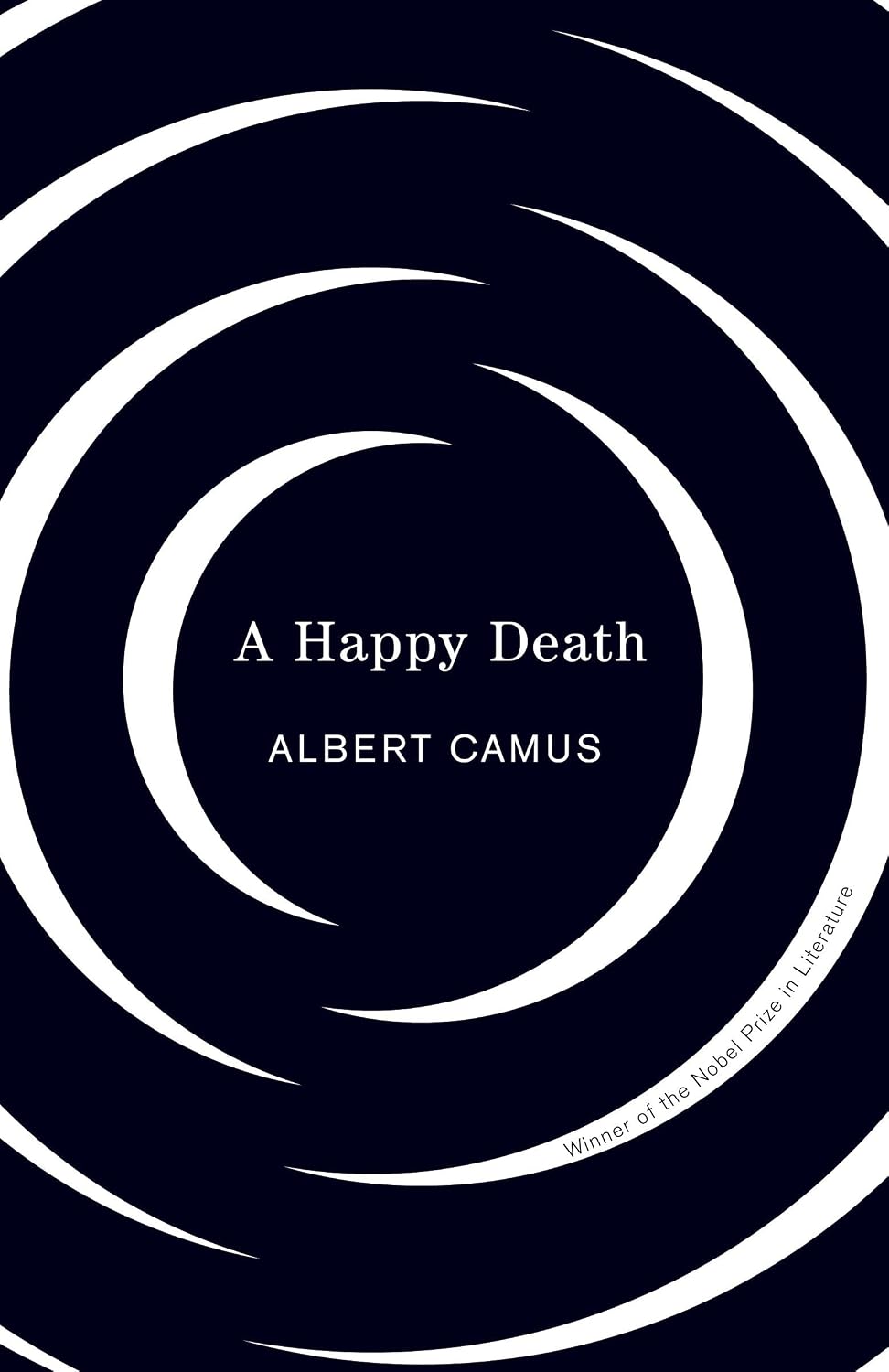
"A HAPPY DEATH"
"AUTHOR(s)":
p5 - wow
p6 - “it seemed as if a man’s one duty was to live and be happy.”
p9 - ‘Why should I hang around with a lot of old men! Every day they tell me they’ve taken some medicine, there’s always something wrong with their liver. I have a better time with my son.’"
p10 - “Mersault wrote his name with one finger on the steamed-up percolator. He blinked his eyes. Every day, his life alternated, from this calm consumptive to Emmanuel bursting into song, from the smell of coffee to the smell of tar, alienated from himself and his interestes, so far from his heart, his truth. Things that in other circumstances would have excited him left him unmoved now, for they were simply part of his life, until the moment he was back in his room using all his strength and care to smother the flame of life that burned within him.”
p11 - “In the past, the poverty they shared has a certain sweetness about it: when the end of the day came and they would eat their dinner in silence with the oil-lamp between them, there was a secret joy in such simplicity, such retrenchment.”
p12 - “He could have found a more comfortable way of life, but he clung to this flat and its smell of poverty. Here, at least, he maintained contact with what he had been.”
p12 - “… on summer nights, he left the room dark and opened the window overlooking the yard and the dim trees. Out of the darkness the fragrance of orange-blossoms rose into the darkness, strong and sweet, surrounding him with its delicate shawls. All night during the summer, he and his room were enclosed in that dense yet subtle perfume, and it was as if, dead for days at a time, he had opened the window to life for the first time.”
p26 - I had noted that I particularly enjoyed chapter 4.
p27 - “‘You look tired.’ … ‘Yes, I don’t know what to do … I feel like getting married, or committing suicide … Something desperate, you know.’ … ==You know a man always judges himself by the balance he can strike between the needs of his body and the demands of his mind.==”
p27 - “‘I don’t like talking seriously. Because then there’s only one thing to talk about — the justification you can give for your life.’”
p28 - “‘Yet I’ll never make a move to cut short a life I believe in so much … I’d accept even worse — blind, dumb, anything, as long as I feel in my belly that dark fire that is me, me alive.’”
p28 - “‘Even now, if I had the time … I would only have to let myself go. Everything else that would happen to me would be like rain on a stone. The stone cools off and that’s fine. Another day, the sun bakes it. I’ve always thought that’s exactly what happiness would be.’”
p30 - “‘I know what kind of life I’d have. I wouldn’t make an experiment out of my life: I would be the experiment of my life. … Before, I was too young. I got in the way. Now I know that acting and loving and suffering is living … but it’s living only in so far as you can be transparent and accept your fate.’”
p31 - notes wow
p31 - ==“Only it takes time to be happy. A lot of time. Happiness, too, is a long patience. And in almost every case, we use up our lives making money, when we should be using our money to gain time. … To have money is to have time. … Time can be bought. Everything can be bought. To be or to become rich is to have time to be happy’…"==
- I first read this as "it takes only time to be happy" meaning "time" as in patience.
p32 - “‘Life should never be tainted with a cripple’s kisses.’”
p33 - “’… everything for happiness, against the world which surrounds us with its violence and its supidity.’ … cruelty of our civilization … happy nations have no history.”
p33 - “‘Don’t think I’m saying money makes happiness. I only mean that for a certain class of beings happiness is possible, provided they have time, and that having money is a way of being free of money.’”
p33 - “‘This life which devours me — I won’t have known it to the full, and what frightens me about death is the certainty it will bring me that my life has been consummated without me. I will have lived … marginally’”
p34 - “‘Don’t take anything seriously except happiness.’”
p38 - “Mersault realized that his rebelion was the only authentic thing in him, and that everything elsewhere was misery and submission.”
p39 - “‘Sometimes there are days when you’d like to change places with him. But sometimes it takes more courage to live than to shoot yourself.’”
p44 - noted: there’s something here, but it hasn’t clicked
p44 - “Around him the flaccid hours lapped like a stagnant pond”
- maybe imagery of the bores of life and of "living".
p45 - wow. “He noticed then that an arched passageway led through the house to the street. It was as if all the voices of the street, all the unknown life on the other side of that house, the sounds of men who have an address, a family, arguments with an uncle, preferences at dinner, chronic diseases, the swarm of beings each of whom has his own personality, forever divided from the monstrous heart of humanity by individual beats, filtered now through the passageway and rose through the courtyard to explode like bubbles in Mersault’s room.” … “opened his being to life”
p45 - “Each time a woman passed him, Mersault waited for the glance that would permit him to consider himself still capable of playing the delicate and tender game of life.”
p48 - “each hour seemed to contain a world.” panic attack?
p53 - “The very monotony of the journey satisfied him.”
p54 - “It takes time to live. Like any work of art, life needs to be thought about.”
p55 - “a traveller lost in a primitive world”
p60 - “his will to happiness had all crystallized around Marthe. He knew now that it was his own will to happiness which must make the next move.”
p60 - “Idleness is fatal only to the mediocre. Most men cannot even prove they are not mediocre.”
p61 - “power to forget that only children have … he understood at last that he was made for happiness.”
p66 - “eight hours she subtracts from the world and her life to give to a typewriter. The girls understand, thinking of what their own lives would be with those eight hours amputaded.”
p66 - “after all, you’re the one who works.”
p73 - “she united her life with her longing for life, identified her hopes with the movement of the stars.”
p73 - “‘On good days, if you trust life, life has to answer you.’”
p73 - “grew aware of the happiness born of their abandonment to the world.”
p77 - “Find your happiness in yourself.”
p79 - “this solitude he had sought so deliberately seemed even more disturbing, now that he knew its setting”
p80 - “Yet he convinced himself that this was what he had wanted: nothing before him but himself for a long time — until the end. He decided to stay where he was, smoking and thinking late into the night, but by ten he was sleepy and went to bed.”
p80 - “The memory of this wasted day embittered him.”
p80 - “deciding to break this solitude from which he had expected so much.”
p81 - “Taking refuge in humanity, he escaped his secret dread.”
p81 - “Everything is forgotten, even a great love. That’s what’s sad about life, and also what’s wonderful about it.”
p82 - “He marvelled at the strange blindness by which men, though they are so aware of what changes in themselves, impose on their friends and image chosen for them once and for all. He was being judged by what he had been.” We have these fixed models and expectations of others (most-commonly identified as when an artist explores something outside their “normal” genre or sound).
p84 - “Happiness implied a choice, and within that choice a concerted will, a lucid desire… will to happiness.”
p84 - “happiness he sought were getting up early every morning, taking a regular swim — a conscious hygiene.”
p86 - happiness is found in habit. not trying to do some grand thing
p86 - “Beyond the curve of the days he glimpsed neither superhuman happiness nor eternity — hapiness was human, eternity ordinary. What mattered was to humble himself, to organize his heart to match the rhythme of the days instead of submitting their ryhthm to the curve of human hopes.”
p86 - “Just as there is a moment when the artist must stop, when the sculpture must be left as it is, the painting untouched — just as a determination not to know serves the maker more than all the resources of clairvoyance — so there must be a minimum of ignorance in order to perfect a life in happiness. … unintelligence must be earned.”
p86 - “‘Get in’” (the ride of life). be spontaneous. avoid obligations.
p87 - is life discovered?
p91 - “‘You make the mistake of thinking you have to choose, that you have to do what you want, that there are conditions for happiness. What matters — all that matters, really — is the will to happiness, a kind of enormous, ever-present consciousness. The rest — women, art, success — is nothing but excuses. A canvas waiting for our embroideries.’”
p91 - “‘if I had my life to live over again’ — well, I would live it over again just the way it has been.”
p93 - “Before, I wanted to be happy, to do what had to be done, to settle down somewhere I really wanted to be, for instance. But sentimental anticipation is always wrong. We have to live the way it’s easiest for us to live — not forcing ourselves. … a ready-made destiny.”
p98 - “Marsault’s life seemed so remote to him, he felt so solitary and indifferent to everything and to himself as well, that is seemed to him he had at last attained what he was seeking, that the peace which filled him now was born of the patient self-abandonment.”
p99 - “submit to this happiness”
p100 - ebbs and flows of life
p100 - “His body which had just now carried him to the limits of joy plunged him into a suffering that gripped his bowels, making him close his eyes. … spasms of shivering.” panic attack?
p101 - “He did not want to abandon his thirst for life, his jealousy of life.”
p102 - leaves / ends the book with notes of hope.
p102 - “tenderness and hope which doubtless dissolved his fear of death, though at the same time it assured him he would find a reason for dying in what had been his whole reason for living.”
p103 - to fear death is admitting that you aren’t alive in life.
p103 - “Of all the men he had carried inside himself, as every man does at the beginning of this life, of all those various rootless, mingling beings … He realized now that to be afraid of this death he was staring at with animal terror meant to be afraid of life. Fear of dying justified a limitless attachment to what is alive in man. And all those who had not made the gestures necessary to live their lives, all those who feared and exalted impotence — they were afraid of death because of a sanction it gave to a life in which they had not been involved.”
p105 - “perfected man’s one duty, which is only to be happy. … what did it matter if he existed for two or for twenty years? Happiness was the face that he had existed.”
- saying that early in life is spent observing and consuming, but eventually you must produce experiences through living.